The AI Anxiety Gap: A Visual Map of Capability, Safety, and Alignment
Bert Ackaert and Captain David Gallimore explore how to balance AI’s rapid rise in capability with the safety, understanding, and governance needed to guide it. Looking through personal, societal, economic, and ecological lenses, they ask how AI can advance human flourishing without leaving people or the planet behind.
Listen on
Central questions
- Is AI capability outpacing our ability to understand and govern it - and how can we close the gap?
- Is speeding up or slowing down a choice to make, or a polarity to manage?
- What does it take to make AI safe and aligned, both inside the lab and in real-world use?
- Whose values and worldviews shape AI - and how can hyperscalers be held accountable?
- Should we keep pushing AI’s capabilities, or focus on putting what we already have to good use?
- How can AI strengthen human agency, meaningful work, and social and ecological flourishing?
Takeaways
Capability is outpacing oversight.
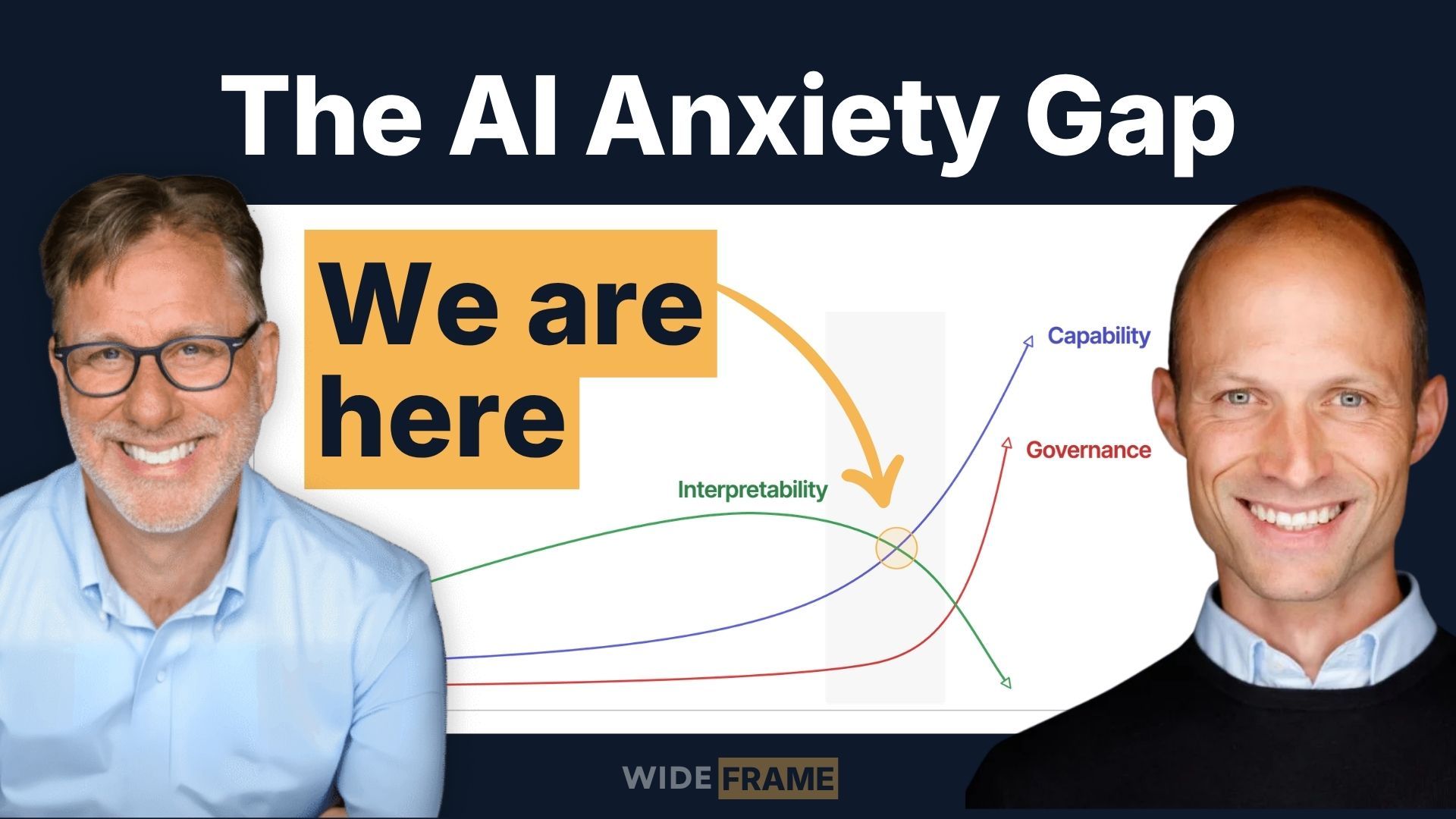
As AI grows more capable, it can become harder to interpret, while governance and safeguards lag behind, creating what we call the “anxiety gap.”
AI innovation and safety are a polarity to manage - not sides to choose.
Innovation can create real benefits, while oversight helps manage risks. The challenge is to support both and watch for the downsides of overemphasizing either.
Release is not the same as safe adoption.
Safety needs to consider both companies’ internal testing and what happens when people use AI in real-world settings.
Values and accountability matter.
AI developers’ goals and worldviews should be made clearer, with oversight that can verify claims and respond when risks emerge. Innovation and guardrails can go together.
Use AI as a tool, not a substitute for understanding.
It can expand our ability to think, create, and connect ideas - but people need to understand its limits and decide how it should support, rather than displace, human agency.
Keep the wider consequences in view.
Consider effects on individuals, meaningful work, society, and the planet - not just technological progress or economic returns. The hosts’ practical call is to ask better questions and scale defenses alongside capabilities.
Show notes
AI is moving fast. How do we make sense of where it’s taking us?
AI can help us think, create, and solve problems in ways that were difficult to imagine only a few years ago. But growing capability brings harder questions: Do we understand these systems well enough to trust them? Who decides what they should do? And are the safeguards keeping pace?
In this first episode of Wide Frame, we - Bert Ackaert and Captain David Gallimore - explore GlossaryAI safetyThe work of identifying and reducing risks from AI systems, both before release and after people begin using them.View glossary beyond the familiar choice between unchecked optimism and impending doom. Bringing our perspectives from Belgium and the United States, we build a visual map of the relationships between GlossaryCapabilityWhat an AI system can do, such as generate text, write code, or perform tasks. More capability can bring greater benefits and greater risks.View glossary , GlossaryInterpretabilityHow well people can understand why an AI system behaves as it does or produces a particular result.View glossary , GlossaryAI alignmentHow well an AI system’s behavior matches the goals, values, and boundaries it is meant to follow.View glossary , and GlossaryAI governanceThe rules, oversight, reporting, and enforcement used to manage AI’s development and real-world use.View glossary - then widen the conversation to consider what AI means for our lives, society, the economy, and the planet.
Understanding the “anxiety gap”
At the heart of our conversation is a mismatch: what AI can do is advancing faster than our ability to explain its behavior and govern its use. We call this the GlossaryAnxiety gapThe growing mismatch between what AI systems can do and our ability to understand, explain, and govern them.View glossary . The point is not that we know less about AI than before, but that our understanding and oversight are struggling to keep up with its expanding capabilities.
We use a visual map to separate what happens inside an AI company (development, testing, safety checks, and alignment) from what happens after release, when people put the technology to work in situations its developers may not have anticipated.
Making a model available is not the same as GlossaryDeploymentPutting a system to work in a real setting, such as a product, a workplace, or a public service, so that people actually use it. This often involves custom applications that use the capability of the technology in a specific way.View glossary it effectively, and neither guarantees reliable GlossaryAdoptionThe extent to which people and organizations actually take up a system and build it into how they work, reliably and over time.View glossary . We explore why safety needs feedback between the lab and the world outside it.
Alignment with whose values?
An AI system can be aligned with its developer’s goals without those goals necessarily matching the needs of everyone affected by it. We ask how founders’ beliefs, commercial incentives, competitive pressures, and national interests shape the systems being built.
We argue that GlossaryWorldviewThe underlying beliefs and values that shape what an organization or person considers important, acceptable, or worth pursuing.View glossary should be explicit enough to examine and challenge. Public commitments also need more than reassuring language: meaningful accountability requires transparency, reporting, independent scrutiny, and the ability to act when real-world risks differ from what a company anticipated.
Rather than treating innovation and regulation as opposites, we frame them as a GlossaryPolarityA tension between two things that may both be needed, rather than a choice where only one can win. For example, innovation and regulation are a polarity to manage, not an either/or choice to make.View glossary to manage: how do we preserve the benefits of experimentation while building safeguards that make progress worth having?
Looking through the wider frame
In the second part of our conversation, we move beyond AI development to explore:
- Individuals: Our experiences with AI as a thinking partner and creative tool - and why understanding its limits matters more than simply keeping up with every new product.
- Society: How we can preserve GlossaryHuman agencyPeople’s ability to make their own choices and act on them, rather than having those choices made for them by technology or institutions.View glossary , connection, dignity, and meaningful contribution as work changes, and how education might better prepare us for uncertainty.
- The economy: Whether competitive markets can provide sufficient oversight, and how commercial incentives interact with public responsibility.
- Ecology: How we weigh AI’s potential environmental benefits against immediate costs and harms, especially when ecological losses may be irreversible.
We hope you enjoy this first episode of Wide Frame!
Quotes
The value is often in the connections between ideas, even more than in the concepts themselves.
 Bert Ackaert
Capability is increasing rapidly, interpretability is falling behind, and governance isn’t there yet. That gap is where the anxiety comes from.
Bert AckaertIf we navigate change from a shared, regenerative worldview, I’m optimistic. If we do it from a reductionist, win-lose worldview, we’re in trouble.
Bert AckaertThe fast-moving parts and the slow-moving parts of a system both have a function. The friction between them can be good: it can slow one down and push the other forward.
Bert AckaertThe gap between capability and governance creates the tension that sparks the AI safety debate
Bert AckaertWe are living through a period of unprecedented change. The goal of Wide Frame is to slow down, zoom out, and see what matters. We discuss what’s changing today, what’s shaping tomorrow, and why it matters to you.
 Captain David Gallimore